Start with the highlights. Go deeper where you’re curious.
Context
Care is personal. The paperwork gets in the way.
Hong Kong’s ageing population puts increasing pressure on geriatric care. BeeCare explores how AI-assisted workflows could give frontline staff more time for direct care.
Read the details +
The project began with the pressure of the impending silver wave on Hong Kong’s geriatric-care sector. My focus was the work around care: how people record, find, and pass on the information they need.
As co-founder and Lead R&D, I led user research and service design and translated social-work requirements into product features and high-fidelity prototypes.
Problem
Three kinds of friction, one everyday workflow.
Research pointed to administrative overload, fragmented information, and digital tools that were difficult for frontline workers to navigate.
Administrative overload
Documentation eats up time meant for direct care.
Fragmented workflows
Information is spread across paper folders and disconnected digital tools.
Digital barriers
Existing systems can be difficult for frontline workers to navigate.
Read the details +
Through user research, we identified a recurring concern: social workers were caught in administrative cycles they experienced as “meaningless.” Documentation took time intended for direct care.
Information was scattered across paper folders and disconnected digital tools. Existing systems could also be difficult for middle-aged frontline staff to navigate.
Research
Listen first. Then decide what to build.
I combined professional input with a modified Delphi process to identify pain points and establish priorities.
Read the details +
I developed and carried out a research framework to ground the solution in professional needs and academic practice. A modified Delphi method helped establish consensus around pain points and priorities. Interviews with veteran social workers at Amazing Grace Care Services added detail about the realities of frontline work.
The wider research and service-design process included contextual inquiry, focus groups, user-journey mapping, and high-fidelity prototyping. These methods helped translate social-work requirements into product decisions.
Desk research connecting worker needs with interface and interaction choices.
Design decisions
Research becomes useful when it changes the interface.
The design responds to visual, physical, and cognitive strain through large text, generous targets, speaking-first input, and simple navigation.
Make it easy to see
Large text and high contrast, chosen for frontline users.
Make it easy to touch
Generous 72px targets in the prototype.
Speak before typing
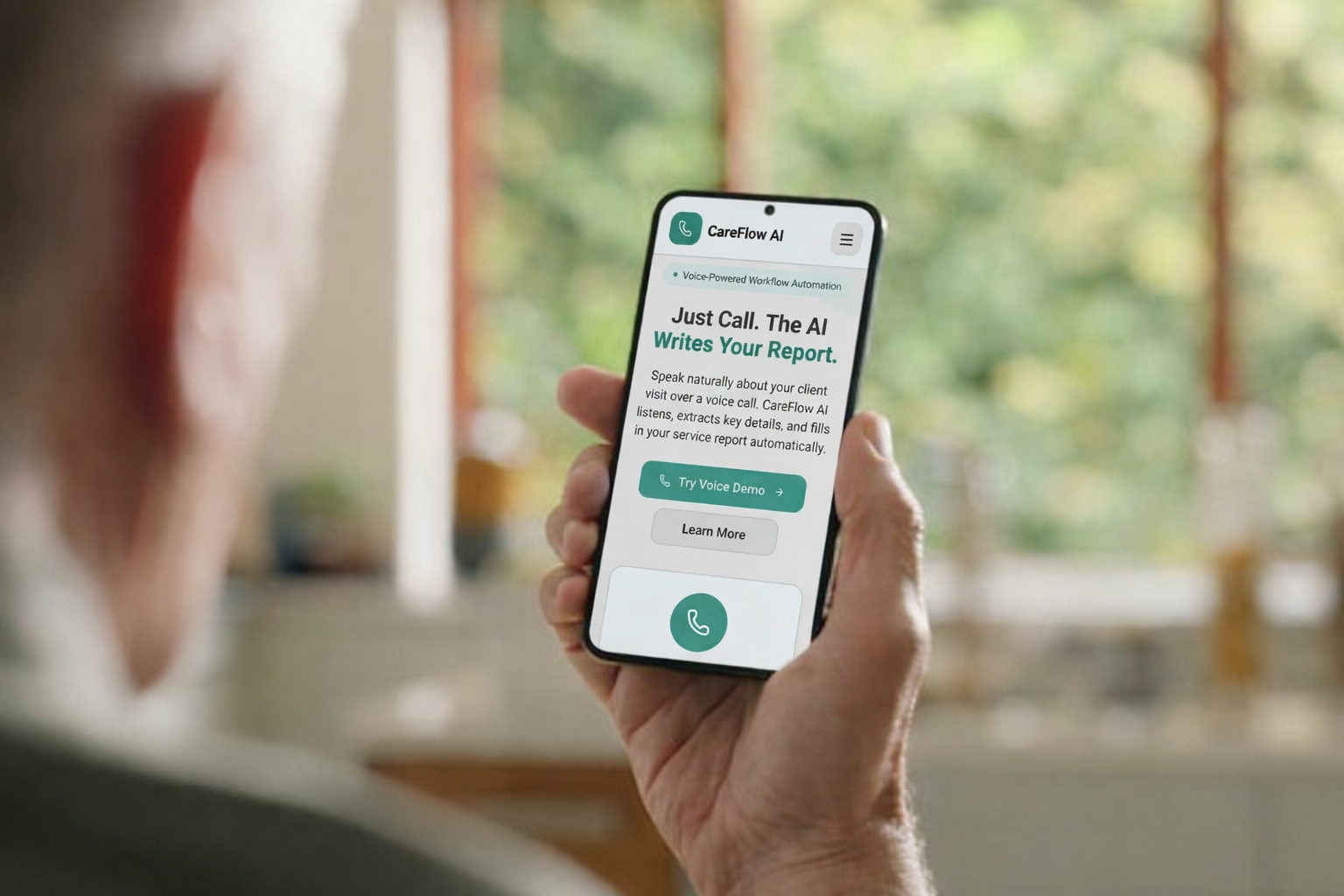
Voice input aims to reduce the burden of writing records.
Keep the path clear
Linear steps and flat menus reduce navigation complexity.
Read the details +
I translated qualitative findings into technical and UX choices. The prototype uses a 26pt minimum font size and high-contrast colours to accommodate declining vision. Touch targets of 72px aim to reduce physical input strain and errors.
To address input fatigue, the workflow shifts from writing-first to speaking-first. Linear navigation paths and flatter menu hierarchies aim to help people stay oriented.
A frontline-worker persona connecting everyday care needs with design choices.
Process
From evidence to a testable experience.
Desk research → data collection → analysis → core functions → experience design → rapid prototyping.
Read the details +
The process moved from desk research and empirical data collection to analysis, defining the main functions, and designing the user experience. AI-assisted rapid prototyping helped visualise the proposed functions.
The process material below preserves the research and interface work behind the shorter overview.
Mapping the existing workflow to proposed improvements.The proposed record-entry and reporting workflow.Information architecture for the proposed care platform.
Solution
Speak once. Keep the care record connected.
The concept brings AI-assisted data entry, a shared workspace, and reusable outputs into one care workflow.
01 / Speaking-first records
Turn spoken observations into structured care documentation.
02 / One connected workspace
Bring the information staff need into one place.
03 / Reusable outputs
Use recorded information across the required outputs.
Read the details +
AI-assisted data entry: caregivers speak and capture moments, with AI proposed to turn that input into structured care records.
A centralised workspace: information is brought together so staff can access it without switching between disconnected tools.
Smart output and automation: the concept is to input data once and reuse it across the outputs staff need. This remains a proposed workflow rather than a claim of a deployed, validated operating system.
The three core features of the proposed solution.Speech-to-text and editable-report concept. The original prototype visuals use the CareFlow label.
Intended impact
Support the people who support everyone else.
Less administrative work for social workers, and care knowledge that can stay with an organisation as staff change.
Read the details +
For social workers, the ambition is to turn documentation that takes hours into work that takes minutes.
For elderly-care centres, the aim is to retain client histories so that an experienced worker’s knowledge can help train the next generation rather than leave with them. The project received PolyU Capstone Project Funding Scheme support and Beijing Delegation funding support.
Reflection
Beyond the screen.
Those who take care of others also deserve to be cared for.
Read the details +
To me, meaningful and impactful design — that can improve people’s lives — is immensely rewarding and needs to be done. In this case, those who take care of others also deserve to be cared for.